Driving Miss Daisy
The Film
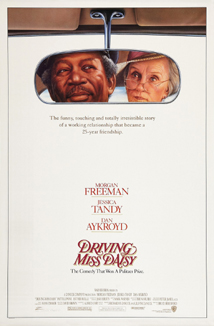
Driving Miss Daisy is a 1989 American comedy drama film directed by Bruce Beresford and written by Alfred Uhry, based on Uhry's 1987 play. The film stars Jessica Tandy, Morgan Freeman, and Dan Aykroyd. Freeman reprised his role from the original Off-Broadway production.
The story defines Daisy and her point of view through a network of relationships and emotions by focusing on her home life, synagogue, friends, family, fears, and concerns over a twenty-five-year period.
Driving Miss Daisy was a huge critical and commercial success upon its release. At the 62nd Academy Awards, it received nine nominations, and won four: Best Picture, Best Actress (for Tandy), Best Makeup, and Best Adapted Screenplay.
Critical Response
Driving Miss Daisy was very well received by critics, with particular praise for the screenplay and performances by Freeman, Tandy and Aykroyd.
The review aggregator Rotten Tomatoes gives the film an 85% rating based on reviews from 104 critics. The website's critical consensus states: "....., Driving Miss Daisy takes audiences on a heartwarming journey with a pair of outstanding actors."
On Metacritic, which assigns a rating out of 100 based on reviews from mainstream critics, the film has a score of 81. CinemaScore similarly reported that audiences gave the film a very rare "A+" grade.
Gene Siskel of the Chicago Tribune declared Driving Miss Daisy one of the best films of 1989. Roger Ebert of the Chicago Sun-Times called it "a film of great love and patience" and wrote, "It is an immensely subtle film, in which hardly any of the most important information is carried in the dialogue and in which body language, tone of voice or the look in an eye can be the most important thing in a scene. After so many movies in which shallow and violent people deny their humanity and ours, what a lesson to see a film that looks into the heart."
Peter Travers of Rolling Stone also gave the film a positive review, calling Tandy's performance "glorious" and opining, "This is Tandy's finest two hours onscreen in a film career that goes back to 1932." The performances of Tandy and Freeman were also praised by Vincent Canby of The New York Times, who observed, "The two actors manage to be highly theatrical without breaking out of the realistic frame of the film."
Awards and Nominations
Driving Miss Daisy received nine Academy Award nominations and also achieved the following distinctions in Oscar history:
- It is the only film based on an off-Broadway production ever to win
Best Picture.
- Jessica Tandy (at age 80) became the oldest winner in history to win
Best Actress.
- It was the first Best Picture winner since Grand Hotel in 1932 to not
also receive a Best Director nomination. That has occurred three times
since: Argo in 2012, Green Book in 2018, and CODA in 2021.
Description: Driving Miss Daisy
Author or copyright owner: Unknown
Source: (WP:NFCC#4) https://https://en.wikipedia.org/wiki/Driving_Miss_Daisy#/media/File:Driving_Miss_Daisy_.jpg
Use in article: Driving Miss Daisy (film)
Purpose of use in article: (WP:NFCC#8) To serve as the primary means of
visual identification at the top of the article dedicated to the work
in question.
Not replaceable with free media because: (WP:NFCC#1) Any derivative work
based upon the cover art would be a copyright violation, so creation of
a free image is not possible.
Minimal use: (WP:NFCC#3) Image will be shrunk
Respect for commercial opportunities: (WP:NFCC#2) The use of a low resolution
image of a work's cover will not impact the commercial viability of the
work.
Cast
Morgan Freeman as Hoke Colburn
Jessica Tandy as Daisy Werthan
Dan Aykroyd as Boolie Werthan
Patti LuPone as Florine Werthan
Esther Rolle as Idella
Joann Havrilla as Miss McClatchey
William Hall Jr. as Oscar
Muriel Moore as Miriam
Sylvia Kaler as Beulah
Crystal R. Fox as Katey Bell
Soundtrack
The film's score was composed by Hans Zimmer, who won a BMI Film Music Award and was nominated for a Grammy Award for 'Best Instrumental Composition Written for a Motion Picture or for Television' for his work.
The score was performed entirely by Zimmer, produced electronically using samplers and synthesizers, and did not feature a single live instrument.
There is a scene, however, in which the 'Song to the Moon' from the opera 'Rusalka' by Antonín Dvořák is heard on a radio as sung by Slovak lyric soprano Gabriela Beňačková.